 Bellingham
 Siding Replacement for York Homes: Built for Bellingham's Climate, Not Just the Sunny Days
York is one of Bellingham's older, established neighborhoods — close enough to the water and to Whatcom County's marine weather patterns that siding here takes a beating most inland homes never see. Salt-laden air off Bellingham Bay, wind-driven rain that gets pushed sideways into wall assemblies, and a moss season that can stretch from fall through spring all combine to shorten the useful life of the wrong siding material. If your home in York is showing cracked boards, soft spots, peeling paint that won't hold, or siding that just looks tired no matter how often it's cleaned, it's worth understanding what's actually happening behind the surface — and what a correct replacement involves.
This page covers siding replacement specifically for York and similar close-in Bellingham neighborhoods: what the local climate does to siding over time, what a proper tear-off and re-install actually requires, and why we only use one product system to do it.
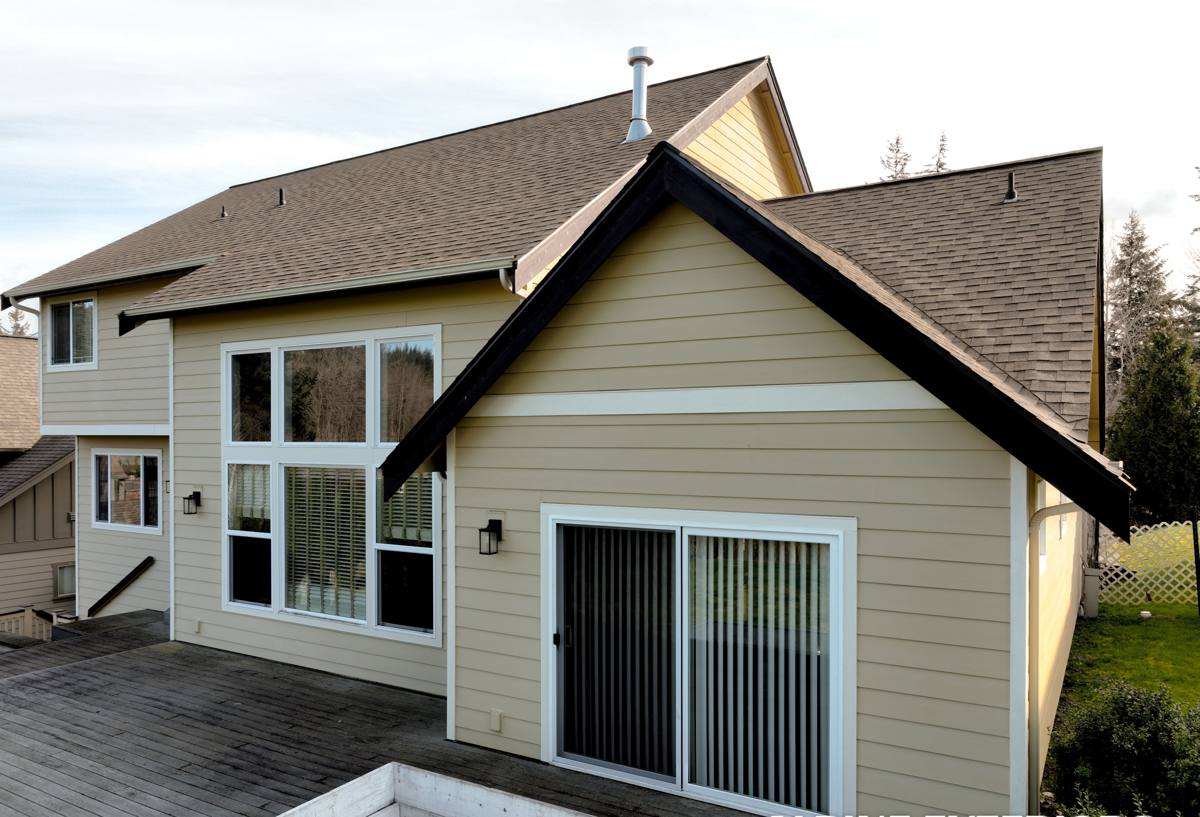
What Bellingham's Climate Does to Siding Over Time
York's location puts it in the path of a few specific stressors that matter a lot more than most homeowners realize until they're dealing with the damage:
- Salt air: Proximity to Bellingham Bay means airborne salt settles on exterior surfaces, accelerating corrosion of fasteners, trim, and any material that isn't rated for coastal exposure.
- Driving rain: Wind off the water doesn't just fall — it drives rain horizontally into siding laps, seams, and butt joints. Materials or installations that rely on gravity alone to shed water fail here.
- Long moss season: Cool, damp conditions for much of the year mean moss and algae find a foothold on any siding that stays consistently damp or has a porous surface. Once established, moss holds moisture against the wall, which is where real problems start.
- Freeze-thaw swings: Whatcom County doesn't get brutal winters, but it does get enough freeze-thaw cycling that trapped moisture in siding or sheathing can do slow, cumulative damage over years.
None of this is unique to York, but older neighborhoods close to the water tend to concentrate the effects — more years of exposure on homes that, in many cases, were sided decades ago with materials that weren't built for this environment.
Signs Your York Home's Siding Has Reached the End of Its Life
Not every siding problem means a full replacement. But there's a point where patching stops making financial sense and a full re-side becomes the smarter move. Watch for:
- Boards that are soft, spongy, or crumbling when pressed — a sign of moisture intrusion into the material itself
- Paint that won't hold for more than a couple of years, no matter the prep or product used
- Visible gaps, warping, or cupping in individual boards or panels
- Moss or algae that returns within months of cleaning
- Rot or staining at the bottom edges of siding, especially near grade or under windows
- Rising energy bills that track with drafts or cold spots along exterior walls
- Siding that's simply reached the end of its rated service life, even if it looks okay from the street
On older homes throughout York, we regularly see siding that's failed from the inside out — the visible surface can look reasonable while the substrate underneath has been absorbing moisture for years. That's why a real inspection during an estimate matters more than a curb-side guess.
Why "It Still Looks Fine" Can Be Misleading
Fiber cement, wood, and some engineered products can hide moisture damage behind paint for a surprisingly long time. By the time bubbling, soft spots, or visible rot show up, the underlying sheathing or framing may already be compromised. Catching this early — before it spreads to structural wood — is one of the biggest reasons replacement timing matters.
What a Correct Siding Replacement Actually Involves
Siding replacement isn't just removing old boards and nailing up new ones. In a climate like Bellingham's, the details that don't show up in a photo are the ones that determine whether the job lasts 10 years or 40. A proper replacement includes:
- Full tear-off and inspection: Removing existing siding to expose the sheathing and framing underneath, checking for rot, moisture damage, or pest issues before anything new goes on.
- Sheathing repair: Replacing any compromised sheathing or framing found during tear-off — this is not optional if the goal is a siding system that actually performs.
- Weather-resistive barrier: Installing a correctly lapped and sealed house wrap or building paper that manages bulk water and allows the wall assembly to dry.
- Proper flashing: Windows, doors, and any wall penetrations need flashing details that direct water out and away from the wall — this is where driving rain finds its way in if it's skipped or done wrong.
- Correct fastening and clearances: Manufacturer-specified nailing patterns, gaps at butt joints, and clearance from grade, decks, and roofing all matter for long-term performance.
- Factory-finished siding installation: Installing the siding itself to spec, with attention to caulking, trim details, and paint-line consistency.
Skipping or rushing any one of these steps is how a siding job that looks good on installation day fails five years later. Most siding failures we're called out to inspect trace back to a shortcut somewhere in this list — not to the product itself.
Why We Install Only James Hardie Fiber Cement
We don't install vinyl, LP SmartSide, Cemplank, Allura, primed spruce, or cedar. That's a deliberate standard, not a lack of options. Each of those products has real strengths, but each also has a trade-off — moisture sensitivity, UV and impact vulnerability, higher maintenance demand, or a warranty structure that doesn't hold up the way homeowners expect — that we're not willing to install and stand behind in a climate like Bellingham's.
James Hardie fiber cement is what we put on homes instead, for a few specific reasons:
- Non-combustible material that doesn't feed a fire the way wood-based products can.
- Climate-engineered HZ product lines — Hardie manufactures different formulations for different climate zones, and the Pacific Northwest HZ5 line is built specifically for regions with sustained moisture exposure like ours.
- ColorPlus factory finish — a baked-on finish applied under controlled conditions, which holds color and resists fading far better than field-applied paint, and doesn't require repainting on the same cycle as wood or primed products.
- Resistance to moss and mildew growth when properly maintained, since the material itself doesn't feed organic growth the way wood-based siding can.
- Strong transferable warranty backed by a large, established manufacturer — a meaningful factor if you sell the home before the siding's service life is up.
- Proven long-term performance when installed to Hardie's specifications, which is why correct installation practices matter as much as the product choice itself.
None of this means other products are junk — it means we've made a professional call about what we're comfortable warrantying our workmanship on, in this specific climate, and we'd rather be upfront about that than install something we don't fully stand behind.
Cost Factors for a York Siding Replacement
Every home is different, and we don't quote pricing without seeing the house, but the factors that move the number are consistent. The table below outlines what typically drives cost up or down on a project like this.
| Factor | Impact on Cost |
|---|---|
| Sheathing or framing damage found during tear-off | Increases cost — repair work is priced once damage is visible, not guessed upfront |
| Home size and number of stories | Larger and taller homes require more material and more scaffolding/staging time |
| Existing siding material being removed | Some materials (old stucco, multiple layers) take longer to strip than others |
| Number of windows, doors, and trim details | More flashing and trim work adds labor time |
| Siding profile and accessories chosen | Lap width, trim style, and accent details affect material cost |
| Access and site conditions | Tight lots, landscaping, or limited staging area can add labor time |
A detailed, in-person estimate is the only way to get real numbers — anything quoted sight-unseen is a guess.
What to Look for in a Contractor Who Works in York
A siding crew that's worked on homes throughout York and similar Bellingham neighborhoods has already dealt with the freeze-thaw cycling, the moss patterns, and the older housing stock common to the area. That experience shows up in the details — flashing choices, clearance decisions, and knowing where water tends to find its way into older wall assemblies. Before hiring anyone, use this checklist:
- Do they inspect and photograph sheathing condition during tear-off, or just cover it up?
- Do they carry manufacturer certification for the product they're installing?
- Is their warranty backed by both the manufacturer and their own workmanship guarantee?
- Do they specify exact flashing and clearance details in the written estimate?
- Are they licensed and insured in Washington State, with proof available on request?
- Do they explain trade-offs honestly, or push whatever product has the best margin?
- Can they speak specifically to how the local climate affects their installation choices?
A contractor who's vague on any of these is a contractor who hasn't done this enough times to have real answers.
Our Process for a York Siding Replacement
The process is straightforward, and we walk homeowners through each stage before work starts:
- On-site inspection and estimate: We assess the current siding, look for visible signs of moisture damage, and measure the home for an accurate quote.
- Material selection: We help you choose the right James Hardie profile, plank width, and ColorPlus color for the home's style and your preference.
- Tear-off and substrate check: Old siding comes off, sheathing and framing are inspected, and any needed repairs are identified and quoted before covering anything up.
- Weather barrier and flashing installation: The wall assembly is prepped correctly before a single piece of new siding goes up.
- Siding installation: Installed to Hardie's specifications, with attention to fastening, gapping, and trim consistency.
- Final walkthrough: We review the finished work with you and go over basic care so the siding performs the way it's designed to.
Caring for James Hardie Siding in a Wet, Mossy Climate
Fiber cement is low-maintenance, not no-maintenance. In a climate that supports moss and algae growth for much of the year, a periodic rinse-down and a visual check of caulking and trim will keep the siding performing at its best. Because the ColorPlus finish is factory-applied, you're generally looking at occasional cleaning rather than repainting cycles — a meaningful difference from wood or primed products over the life of the siding.
If you're seeing early signs of wear on your current siding, or you're just ready to stop patching and do it right, we're happy to walk your property and give you an honest read on where things stand. Reach out for a free, no-pressure estimate using the form below.